
Whether you’re looking to advance your professional development or expand your personal knowledge, the Global Affairs & U.S. Foreign Policy Institute is an excellent opportunity to gain a more comprehensive grasp of the world as it is today, and what factors will shape it in the years ahead. The Institute offers a dynamic learning experience designed to equip you with the skills and insights needed to navigate, understand and prepare for global events.
Why Choose the Institute?
- Deepen your understanding of global issues, enhancing both your personal and professional perspectives.
- Apply what you learn directly to your career, improving your decision-making and leadership abilities.
- Gain insider knowledge from guest speakers with firsthand experience in international affairs, diplomacy, security, politics and more.
- Earn a certificate that highlights your commitment to understanding and addressing global challenges, enhancing your professional profile.

Learn from the Best
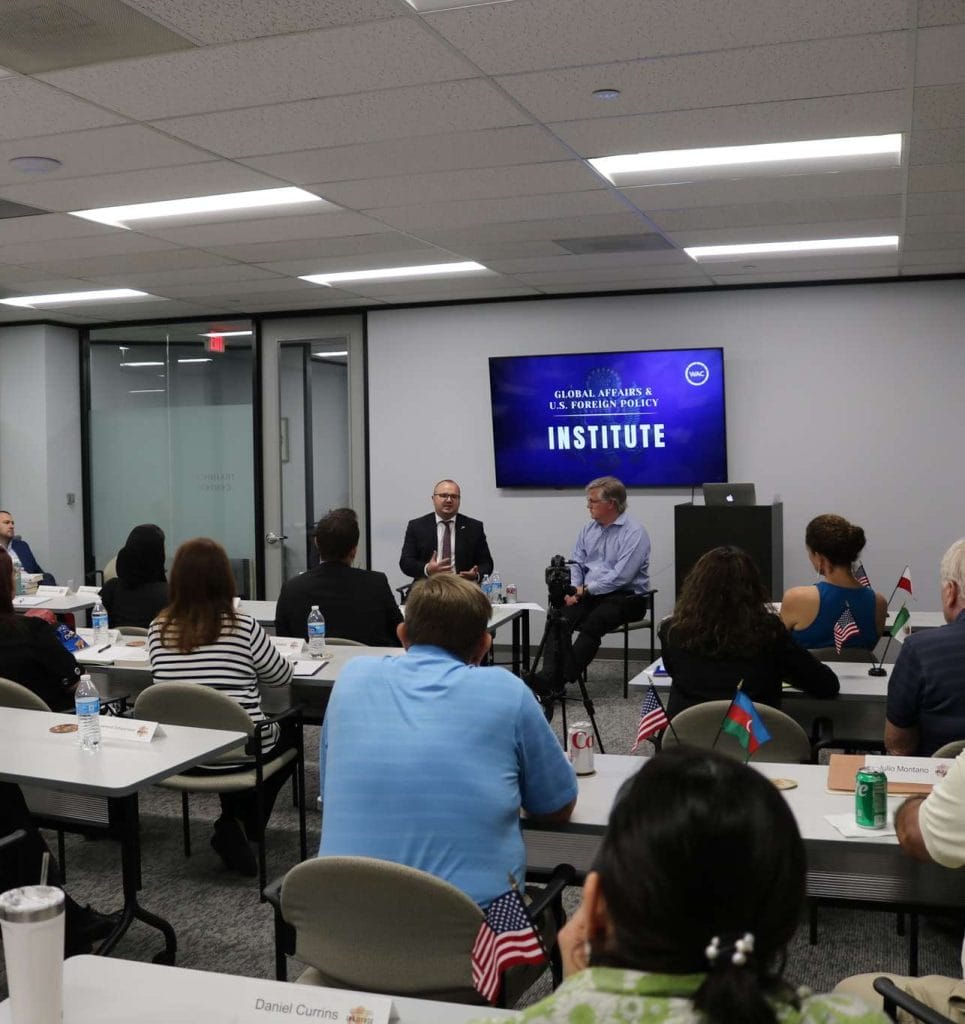
Our program features distinguished guest speakers who bring real-world experience to the classroom. Some past experts have been:
- Former FBI Special Agents
- Former CIA Agents & Analysts
- Former U.S. Ambassadors
- Middle East Journalist & Analyst
- Former Cybersecurity Expert for the U.S. State Department
- New York Times National Energy Business Correspondent
A similar selection of experts will join at each part of the Institute. Each session provides opportunities to engage directly with these experts, asking questions and participating in stimulating discussions.
Program Highlights
- Classes are held once a week on Tuesdays from 6:00 – 8:45 pm, including a 10-minute break.
- Receive background reading materials before the start of the session and weekly updates.
- In the final session, students can present on a topic of their choice, demonstrating former or newfound expertise.
- Part I is not a prerequisite to Part II or Part III.

Course Overview
Part I – ‘How the Modern World Order Came to Be & the U.S.’s Role in the World’
Examine the historical events and decisions that have shaped today’s geopolitical landscape. Understand the U.S.’s strategic role and interactions with other major powers, such as China and Russia, and critical regions like the Middle East. Explore the impact of energy, globalization, nuclear proliferation, alliances, and cyber threats on world events.
Part II – ‘Dictators, Democracies & Difficult Decisions'
Analyze the complexities of U.S. foreign policy towards autocratic regimes. Learn the historical and contemporary strategies used to manage relationships with dictators and understand their implications on global stability and democracy. Discover how dictators and autocrats come to power, and the tactics they use to remain in control.
Part III –'The Eternal & Enduring Revolutions Still Shaping our World'
While some powerful revolutions may have occurred a few years or a few decades in the past, their echoes continue today, shaping crucial leaders and players in vital parts of the world. What the U.S. did learn or should have learned from these rebellions, continues to shape our nation’s foreign policy decisions – and influence the likelihood of success or failure of our nation’s critical global aspirations.
For more information, please email programs@wachouston.org or call the Council at (713)522-7811.
Curriculum
Part I - 'How the Modern World Order Came to Be & the U.S.'s Role in the World'
- How the Modern World Order Came to Be Course Overview & Student Introductions
- The Rise of the U.S. & Its Involvement in Latin America
- Special Topics: The U.S.’s Role in the Middle East & How Energy Shapes Geopolitics
- How WWI, WWII & the Cold War Shaped the Modern World Order
- The Rise of China, the Resurgence of Russia & Other Challenges for Democracy & U.S. Influence
- U.S. Foreign Policy Since 9/11 & the Challenge of Global Cybersecurity Threats
- Considerations & Concerns for the Years Ahead’ & Student End of Course Presentations